
Margin per day
margeparjour · v1.0.2
You see what a working day brings in before you accept the quote.
dolixretrait · version 1.0.2
The customer comes to collect a pre-order: one click in TakePOS copies it into the ticket, and after payment the order is classified billed, even if the weight changed.
Sold directly to businesses in France
Direct purchase, with immediate download and an invoice by email, is open to businesses and associations established in France, on the French page of this module. From elsewhere, write to support@dolix.fr.
Try it without installing anything: the online demo (login demo, password demo; sample data, reset every night; the demo is in French).
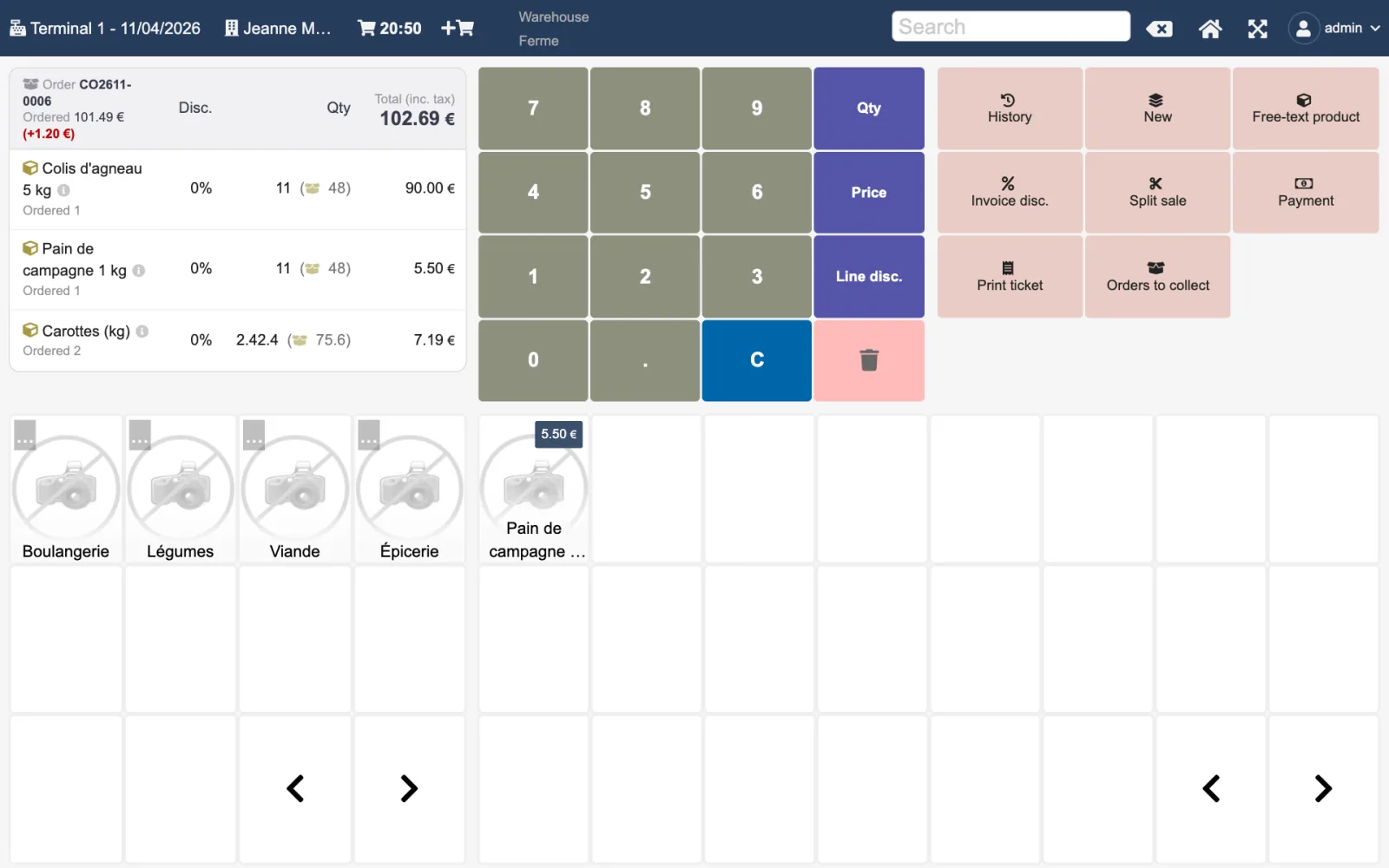
The customer ordered in advance, by phone, on the website or at the previous market. On collection day, TakePOS cannot find the order: the products have to be keyed in again at the till, then the order classified by hand. And if the actual weight changes, the Dolibarr rule that classifies the linked order billed no longer applies, because it requires an identical amount.
The customer ordered in advance: by phone, on the website, or at the previous market. The order is entered in Dolibarr. On collection day, they come to pick it up and pay at the till.
TakePOS cannot find that order. The products have to be keyed in again in the ticket, then the order classified by hand back in Dolibarr.
And the actual weight often changes: 2.4 kg of carrots instead of 2. The Dolibarr rule that classifies the linked order billed requires an identical amount; as soon as the amount changes, it no longer applies.
Who it is for: Farmers selling direct, bakeries, butchers, grocery shops, farm shops: any business that takes orders in advance (phone, website, market) and takes payment with TakePOS when they are collected.
This section appears on all 29 module pages, without exception.
An “Orders to collect” button is added to the TakePOS action bar. It opens a window listing the sales orders that are:
For each order: the reference, the customer, the customer reference, the planned delivery date and the amount including tax. A search covers the reference, the customer or the customer reference. If the ticket already has a customer, the list is filtered on that customer, with an “All customers” link.
One click on “Put into the ticket” copies the order into the current ticket: customer, products, quantities, prices, discounts and VAT. If there is no ticket yet, the draft is created the way TakePOS does it, with the same temporary reference.
The cashier adjusts quantities (actual weight), adds or removes products, then takes payment as usual. The floor plan (restaurant mode) works too.
On screen only, the module recalls the order:
The printed ticket is not changed.
When TakePOS validates the ticket, the module:
This step never blocks a sale: if the classification fails, the error is only written to the Dolibarr log. If the cashier changed the ticket customer after taking the order in, the order is left untouched.
If the ticket is emptied or deleted before payment, the link is removed: the order is back in the list.
TakePOS asks for a lot for each lot-managed product. The module chooses it for the cashier: the lot that expires first and holds the quantity, in the till warehouse (or in all warehouses if the till does not impose one). If a product is on several lines, each line takes into account what the previous lines already took from a lot.
If no lot is enough and the till takes stock out, the order is refused before the ticket is touched, with a clear message.
Taking an order in is refused, with a message, if:
These orders are invoiced from Dolibarr, as before.
The ticket filled from order CO2611-0006 of Jeanne Martin, on Dolibarr 24.0.2 in English. In the header: “Order CO2611-0006”, “Ordered 101.49 €” and the difference, “(+1.20 €)”. The carrots were weighed at 2.4 kg for 2 ordered; under each line, “Ordered” recalls the ordered quantity. The “Orders to collect” button is in the action bar, on the right.
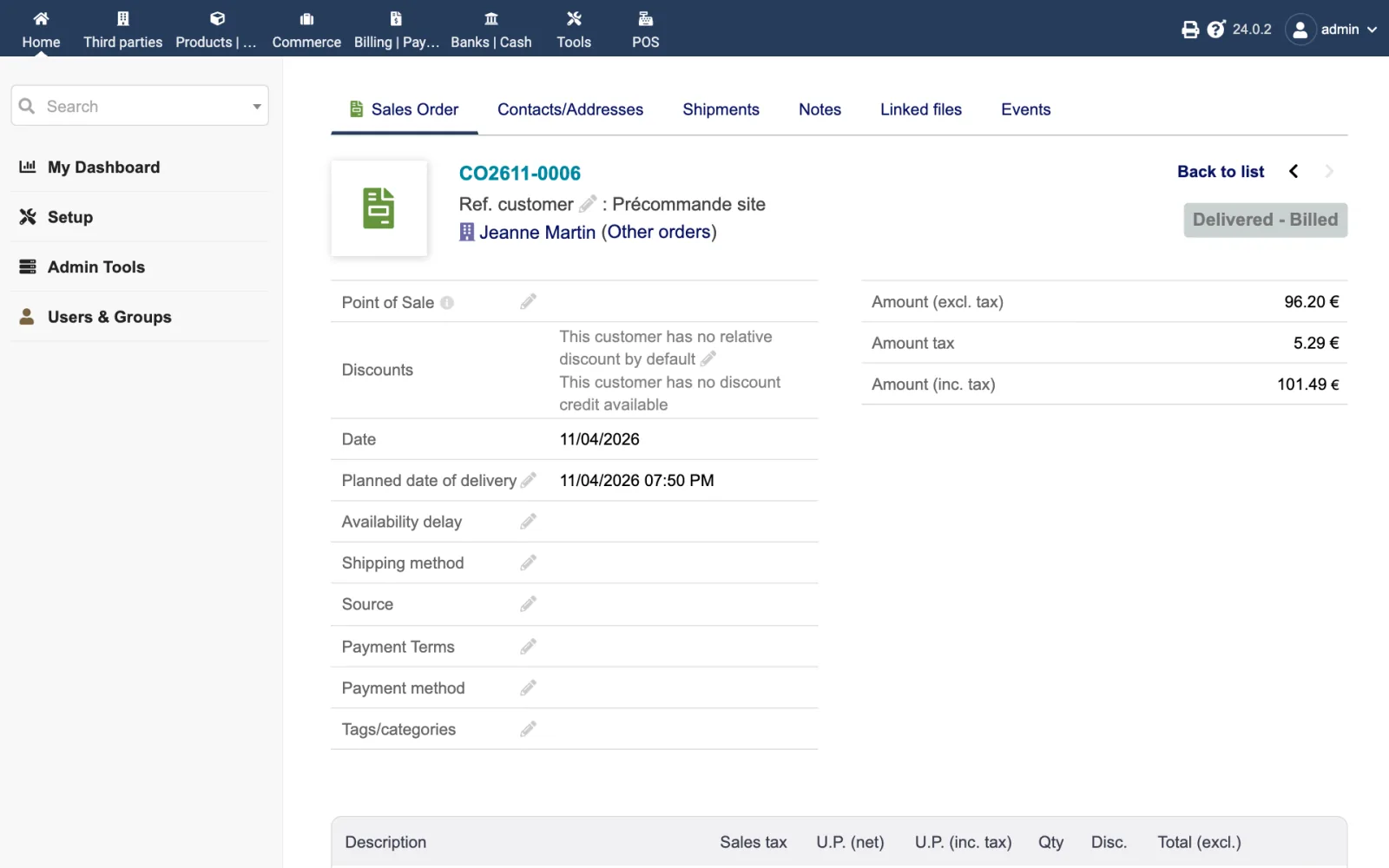
After payment, order CO2611-0006 is classified “Delivered - Billed”.
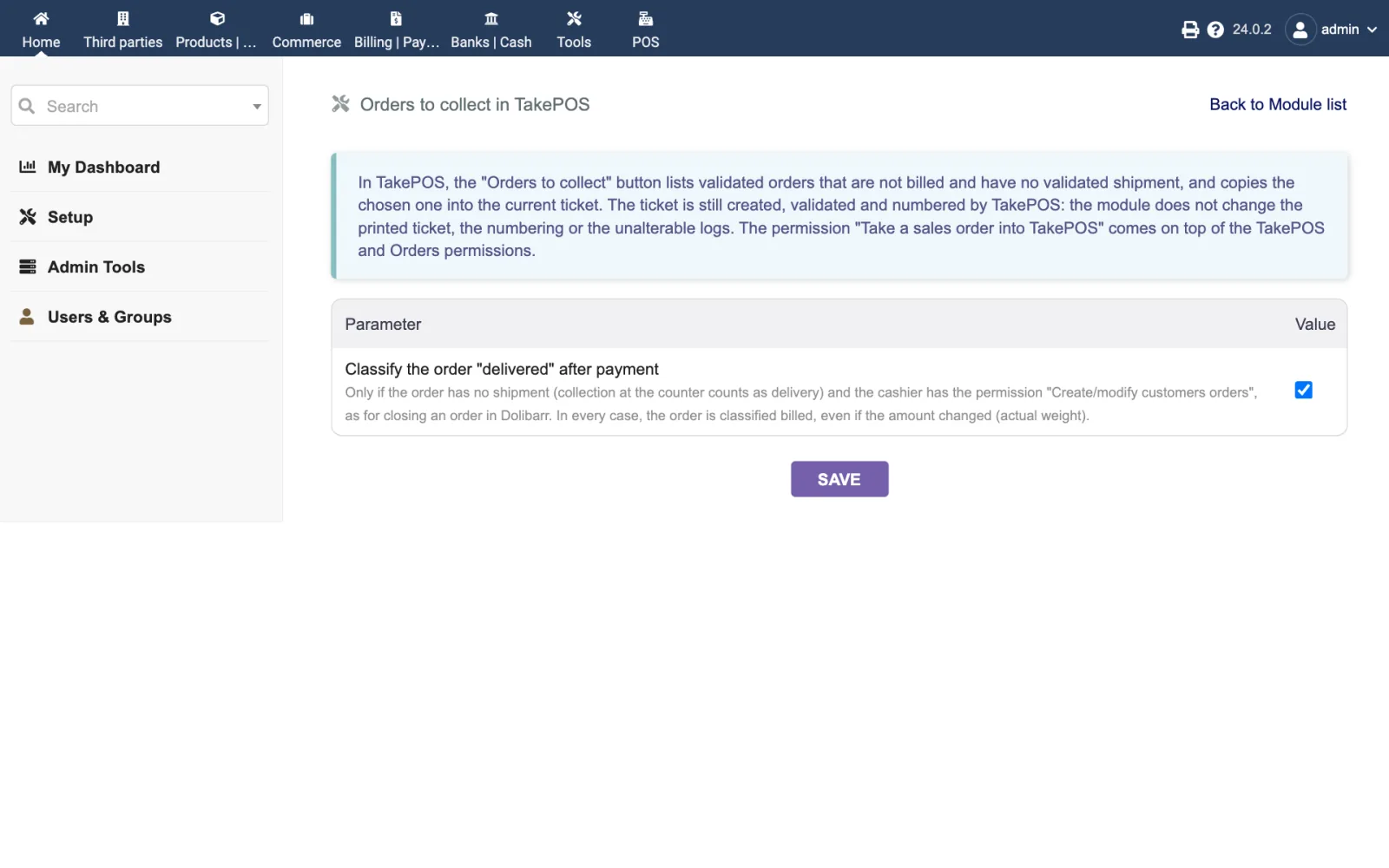
The setup page is reserved for administrators. It recalls what the button does and what the module does not touch (printed ticket, numbering, unalterable logs).
| Setting | Default | Effect |
|---|---|---|
| Classify the order “delivered” after payment | ticked | Only if the order has no shipment (collection at the counter counts as delivery) and the cashier has the permission “Create/modify customers orders”. In every case, the order is classified billed. |
| Database tables created | Two small tables. llx_dolixretrait: which ticket was filled from which order (with the user, the date and the entity); it is used to recognise these tickets at payment. llx_dolixretrait_ligne (since 1.0.1): which order line each ticket line comes from, with its ordered quantity; it is used to show “Ordered” under the right line. The visible link between the order and the ticket (“Related Objects”) is Dolibarr's own. |
|---|---|
| Permissions | One permission, “Take a sales order into TakePOS”, not granted by default. It comes on top of the permission to use TakePOS and the permission “Read customers orders”: without all three, no button and no window. The list only shows customers the user can see in Dolibarr: without the permission to see all third parties, only those they are the assigned sales representative of. For the order to be classified delivered, the cashier also needs the permission “Create/modify customers orders” (or, with advanced permissions, the one to close orders). The setup page is reserved for administrators. |
| Uninstalling |
|
dolixretrait, to put in htdocs/custom/ or to install from the zip.fr_FR), English (en_US), German (de_DE) and Spanish (es_ES).ChangeLog.md) in the module folder; no README.llx_dolixretrait keeps one line per ticket filled from an order:
ticket, order, user, date, entity. llx_dolixretrait_ligne keeps, for each ticket line, the
order line it comes from and its ordered quantity.The module descriptor only declares a minimum version. No upper bound is written in the code: the versions below are those on which the module has actually been run.
| Dolibarr versions | Dolibarr 19.0 minimum. Tested on 19.0.4, 20.0.4, 21.0.4, 22.0.5, 23.0.4, 24.0.1 and 24.0.2; till walkthrough also run on 24.0.3. |
|---|---|
| Minimum PHP | 7.4 |
| Dolibarr modules to enable | Sales Orders, Invoices, POS TakePOS |
| Licence | GPL v3 or later, full source code |
| Languages | French, English, German, Spanish |
| Menu | No menu entry. An “Orders to collect” button in the TakePOS action bar, and a setup page reached from the module list. |
The test results, Dolibarr version by version, are on the Compatibility tested page.
The details — permissions on the custom folder, shared hosting, upgrades, uninstalling — are on the page Installation and upgrades.
The descriptor requires Dolibarr 19.0 and PHP 7.4 at least. Version 1.0.1 passed its integration tests (45 out of 45) and its lot tests (11 out of 11) on 19.0.4, 20.0.4, 21.0.4, 22.0.5, 23.0.4, 24.0.1 and 24.0.2 with MariaDB, and on 19.0.4 and 24.0.2 with PostgreSQL. A real walkthrough at the till (button, order taken in, payment, order classified billed and delivered) was run in a browser on these seven versions and on 24.0.3. If in doubt, write before buying.
No. It fills the TakePOS draft ticket, with the same temporary reference as TakePOS. Validation, numbering, payment and printing remain TakePOS's. With the restrictions of the certified till version (the core's test mode), tried on 23.0.4 and 24.0.2, the unalterable log chain stays intact.
Change the quantity in TakePOS as usual. The difference is shown in the ticket header, and the order is still classified billed after payment. The Dolibarr rule, for its part, requires an identical amount.
The link to the order is removed: it is back in the list and can be taken in later.
No. An order with a deposit or credit note discount is refused with a message, and is invoiced from Dolibarr.
No, so that stock does not go out twice. Invoice it from Dolibarr, as before.
TakePOS asks for a lot for each lot-managed product. The module takes the lot that expires first and holds the whole quantity, in the till warehouse; if the same product is on several lines, it takes into account what the previous lines already took. If no lot is enough and the till takes stock out, the order is refused with a clear message: invoice it from Dolibarr or transfer stock.
Disable then re-enable the module in the module list, to create the new 1.0.1 table. No data is lost. Until then, the till works normally; only “Ordered” is not shown under a product that is on several lines of the order.
Support is provided by the person who wrote the module, at support@dolix.fr. The module is bought directly on dolix.fr (businesses and associations established in France); new versions remain downloadable for two years at dolix.fr/telecharger/. Private individual or outside France: write to support@dolix.fr.
Taken from the module’s ChangeLog.md file: a single source.
1.0.214 November 2026
Stock taken out twice: with the Dolibarr setting “decrease stock on sales order validation”, a till that also takes stock out took it out a second time at checkout. Taking over such an order is now refused, with a message. Nothing changes if the till does not take stock out. Tested on 19.0.4 to 24.0.3, with and without lots.
1.0.112 November 2026
Same product on several order lines (for example 2 kg and 1 kg of the same ham): under each ticket line, “Ordered” gives the quantity of its own order line, no longer the product total; for lots, each line takes into account what the previous lines already took, so a lot is no longer assigned beyond its stock. New llx_dolixretrait_ligne table. After updating from 1.0.0: disable then re-enable the module (no data lost). Tested on 19.0.4 to 24.0.2.
1.0.04 November 2026
First version: “Orders to collect” button in TakePOS, order copied into the ticket, order and difference reminder on screen, order classified billed and delivered after payment, automatic lot choice, clear refusals. French, English, German, Spanish.
Write to support@dolix.fr. The person who wrote the module is the one who replies.
Reply within two working days. This is not an on-call service.
To include in your message
Sold directly to businesses in France
Direct purchase, with immediate download and an invoice by email, is open to businesses and associations established in France, on the French page of this module. From elsewhere, write to support@dolix.fr.
margeparjour · v1.0.2
You see what a working day brings in before you accept the quote.

dolixdomaine · v1.0.8
A customer changes its name: its addresses move to the new domain in a single operation.

dolixmasse · v1.0.9
You change a field across a series of records without writing an SQL query.
dolixtaches · v1.0.5
A task was created in the wrong project: you move it, with its subtasks, its time spent and its documents.

dolixdoublons · v1.1.8
You find records entered twice and merge them: third parties, contacts and members.
dolixprix · v1.1.4
Your draft quotes and template invoices pick up the catalogue prices, one by one or all at once.

dolixapproche · v1.0.6
You spread freight, customs and the other costs of a shipment over the cost of products and their weighted average price.

dolixresteafacturer · v1.0.3
You see what remains to be invoiced on each customer order, line by line, in quantity and in amount excluding tax.

dolixmaj · v1.1.2
Before upgrading Dolibarr, you know how far you can go, what will stop working and what to do first. The module changes nothing.

dolixtva · v1.0.1
The mandatory VAT statement is printed on your invoices by itself: small business exemption, intra-Community supply, reverse charge, export.

dolixjustif · v1.0.1
The expense report PDF also contains its receipts, photos and PDFs, page by page: one single document to hand over.
dolixportemonnaie · v1.1.1
Your customers or members pay an amount in advance, and TakePOS spends it at each visit to the till, until it runs out.

dolixmondialrelay · v1.0.2
You choose the recipient's Point Relais® or Locker on the shipment, and the module creates the Mondial Relay label with your Sendcloud account.

dolixdlc · v1.0.1
You see in time the lots in stock whose sell-by or eat-by date is near or past, and you can prevent the validation of a shipment that contains a lot past its sell-by date.
dolixhabillage · v1.0.3
Make TakePOS look like a modern till: category tabs, large product grid, basket on the right, Charge button, trade looks or your logo colours.
dolixtags · v1.0.1
The tags of your proposals, orders, invoices, third parties, contacts, products and projects are shown in colour in a column of the list, without opening each card.
dolixcotisations · v1.0.4
A membership fee for each member, and all subscriptions renewed at once, with invoice, payment and email.
dolixconsignes · v1.0.2
You see how many returnable kegs, crates or pallets each customer holds, what those deposits are worth, and which ones have not come back in time.
dolixdepotvente · v1.0.4
For each consignor, you see what was sold and your commission, and the statement prepares the invoices as drafts.
dolixblgroupe · v1.0.3
One single PDF delivery note for several shipments of the same customer, signed only once.
dolixdernierprix · v1.0.2
You pick a product on a proposal, order or invoice: the last price and discount granted to that customer are shown, and applied in one click.
dolixmultibarcode · v1.0.1
Several barcodes for one product: supplier code, old code, in-store label, pack code. Scanned in TakePOS, each code adds the product to the ticket with its quantity: the code of a pack of 6 adds 6 units.

dolixcloture · v1.0.0
Bank deposits, withdrawals to the safe, cash in and cash expenses recorded from TakePOS, a count by notes and coins, and the discrepancy booked so that the cash account matches the drawer.

dolixoss · v1.0.0
For your sales of goods to consumers in other EU countries: the VAT rate of the customer's country, found from the product's customs code and the European Commission's official rates, draft invoices fixed in one click, tracking of the €10,000 threshold and the quarterly OSS return.

dolixcalc · v1.0.0
An extra field computed by a formula written without PHP, with its value stored: right in the lists, sortable, filterable and printable on PDFs.

dolixshortcuts · v1.0.0
Ctrl+S (Cmd+S on Mac) saves the record you are filling in, without scrolling down to the button. g then a letter opens third parties, proposals, orders, invoices or products. ? shows the help.
dolixgcontacts · v1.0.0
Dolibarr contacts and Google Contacts synced both ways, for each user. Only the contacts with the “Dolibarr” label in Google are involved, and a field changed on both sides is settled by the rule you chose.
dolixcoop · v1.0.0
For cooperative and community grocery stores: shelf labels with the price per kilo or per litre, the customer's membership status in the TakePOS checkout, a simplified home page and menu for volunteers, a quick inventory on the phone.